My wife and I came together some time ago.

We'd known each other, but hadn't seen each other face-to-face in several years.  We were emerging from very dark periods, maybe our darkest.

When we started dating, we were 1,000 miles apart.  When we realized we were meant to be together, we felt it.  It was a matter of faith.

So, like any romantic, I wanted to show her the strength of that faith.  I thought, "Any guy can promise the Moon.  I'm gonna deliver."

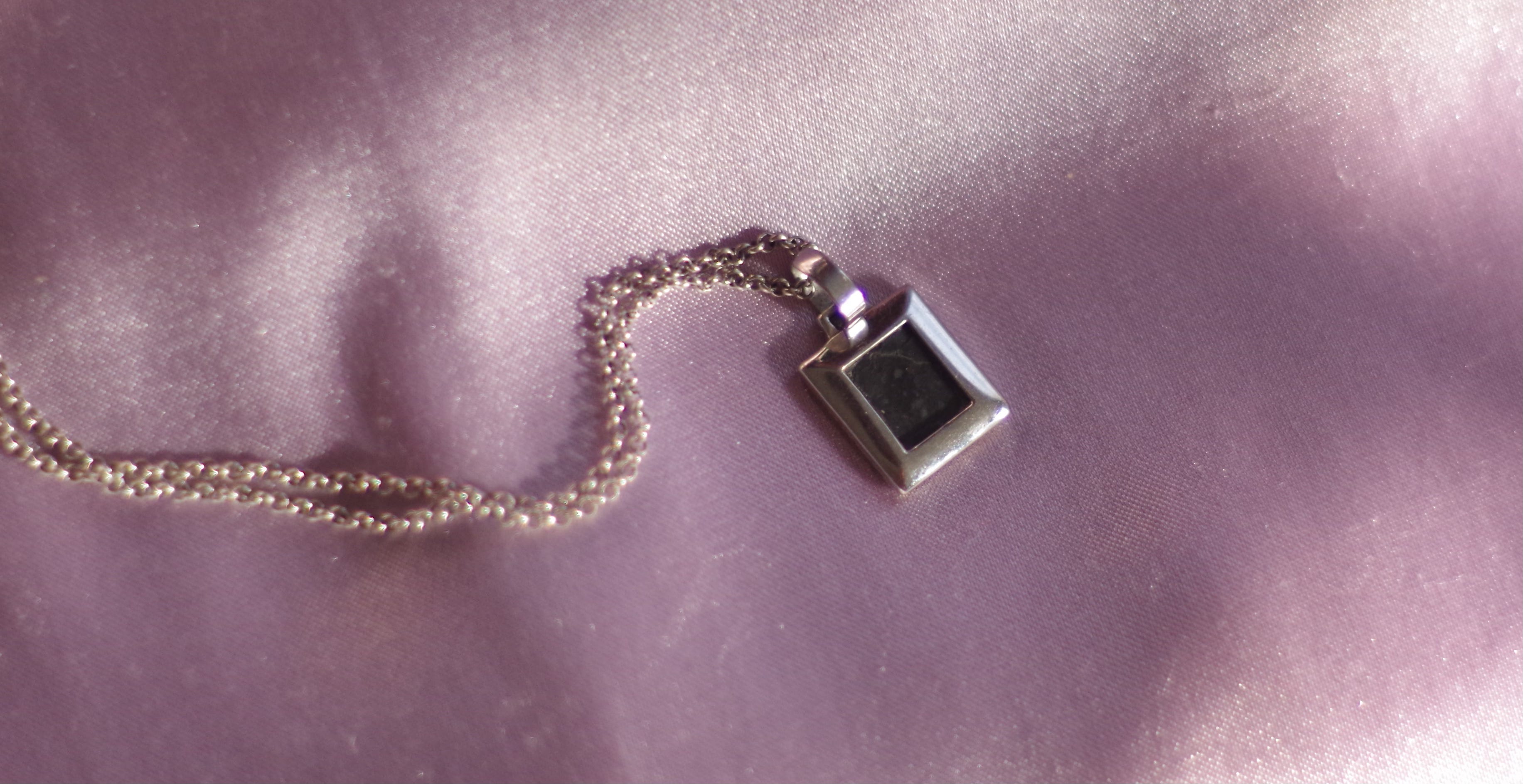
And I did.  Ordered a slice of lunar meteorite NWA 7948 from an expert I trusted, and had it placed in a pendant – fully exposed, so at any moment she could touch the small sliver of rock and know she was touching the Moon.
There really is a meteorite for everything
That sentiment came with a little background.  In grad school, I studied at the Planetary Geosciences Institute at the University of Tennessee, Knoxville.

I got to hold meteorites that were as old as the Earth – in fact, they're what we use to measure Earth's age.  (Basically, "The Age of the Earth" is the age of crystals in some meteorites, crystals that condensed out of gas and dust in our hot, young solar system.)

Some even contain tiny, microscopic diamonds that came from outside our solar system, so they predate our sun.  I cannot even begin to convey the gravitas.

Meteorites have since become milestone gifts for me.

I gave a beautiful slice of iron meteorite to my grandfather on his birthday, the criss-crossing Widmanstätten structure on its surface screaming Not of This World.

I gave a slice of chondrite to my 8th grade algebra teacher on his retirement, a timeless thank-you for helping shape how I learn.  ("We're going for understanding, here," he would say.  He would stop class until he was sure you truly grasped his answer to your question.)

Never before had I given the Moon.

Seeing and believing
So, how do we know, "This is a piece of the Moon"?

Experts tell us it is, but there's nothing an expert knows that we can't learn.

For NWA 7948, the owner at the store where I bought it had done his homework.  There was in-depth research that he could point me to – there's now even a study that suggests where on the Moon the meteorite may have come from.

But, showing a rock came from the Moon is a high bar.

We all believe things on faith, and learn things from observation, and those approaches are not mutually exclusive, they fit different situations in life.

Testing moonrock fits squarely in the observation camp.

That looks like a rock.  Poke it.
For NWA 7948, the first evidence that This is Not From Here was pretty clear.

Someone wandering the desert in Northwest Africa (the NWA of NWA 7948) spotted a rock on the ground that looked nothing like the rocks or sand around it.

In fact, that's how most meteorites these days are found, from scouting deserts in Northwest Africa or ice fields in Antarctica – they're the best places to find rocks that stand out.

One early clue this was a space rock was the fused sheen of its crust, burned into the meteorite as it passed through the atmosphere.  When the rock was sliced open, things got really interesting.

Inside, the dark fabric of the meteorite was embedded with countless little bits and pieces, mineral grains that told a complex—but familiar—story.

Rooooocks frooooom Spaaaaace*
For NWA 7948, all the clues matched rocks from the Moon – not only the more than 300 confirmed lunar meteorites, but also the rocks humans actually picked up off the Moon, from the NASA Apollo program.

These days, microscopes and probes can show not only what minerals make up a rock (minerals are to a rock what a chocolate chip is to a cookie), they can show what atoms make up those minerals – even the proportions of those atoms in relation to each other.

Fingerprints within fingerprints within fingerprints.

There was a lot to go on.  And you don't even know what you don't know – though you can get a sense for it reading the research paper I mentioned above.  Its authors from China and the U.K. spent months—if not longer—pulling together the various lines of evidence.

What we see and what we believe
My grandfather (the other one) did not believe we landed on the Moon.  A beautiful man, who was trusting in his relationships, was not so trusting of the space race.  He simply thought landing on the Moon was impossible.

At the time, the Soviets would have called out any attempt at fakery.  They would have been pretty insistent.  But my grandfather, like a lot of folks, had to see things with his own eyes – especially the most extraordinary things.

Everyone comes to a discovery, to any new information, from a different place.  We each bring different observations and beliefs, our experiences good and bad.  The lessons we learn from those experiences show up thereafter; lack of trust is a common one.

In science, testing—and re-testing—helps address that trust.  Even Einstein is still getting tested.  Constantly.

One of his wackiest ideas—that events in the cosmos shake the actual fabric of space and time, producing gravitational waves—seemed impossible to prove.  Until a huge team of researchers at the NSF LIGO detector did it, in 2015.  (For their efforts, the leaders of that team earned the Nobel prize two years later.)

We're only human
Scientist or not, we all have insights and ideas, and fears and frustrations.  In every interaction with each other, we bring all that to the table.

We bring our beliefs, which we accept on faith, and we bring our ideas, which we base on observations.

Every one of us comes into a relationship with a perspective that's equally valid, because those are our experiences.  They exist.

That's true in every single human endeavor, whether asking someone for help moving your car or asking someone for their hand in marriage.

Three opportunities to gather data
When I first met my wife, we were in college, across the room from each other in ballroom dance.  We paired up, and something clicked.  Until it didn't.

When I next met my wife, it was years later, I was working at NSF.  I went to a meeting, she was there.  I thought, "Hey, that's that girl who wanted to break up after like only two dates."  She thought, "That guy looks familiar – didn't he also go to William and Mary?"

We'd moved on, happily, to be with others.  Our past was more context for surprise than a rekindled spark.  And over time, life and geography sent us on our separate ways.

Then, one New Year's, I found myself in a bad place, going through a divorce that I did not want – at just the time, it turned out, as she was doing the same.

We helped each other navigate one of life's worst crises for the better part of a year.  Not romance, just moral support.

Believe it
And then, something clicked.

For the first time, we really knew each other.

We had reconnected three separate times, seemingly at random, and at each point were given the opportunity to investigate further.

On faith, we knew we were brought together for each other.  As years came and went, that faith was tested, but it never failed.

Observations would lead us to ask questions, and data points weren't always easy to find.  Yet, with every crisis we've built evidence about who the other person is.  In time, we became experts in Us.

It takes a true professional
Last year was hard.  My last few years have been challenging.  I've had to face conflicts and make decisions that weakened me.  I've doubted myself, and my purpose, and my place.

My wife never had those doubts.

With patience that seems not human, and compassion that very much is, she steadied me, and supported me, and lifted me.  Day.  After day.  After dark and clouded day.

We move forward, and we move forward together.

Relationships are not built on the permanence of the things we give each other, but the permanence we create.  She knows who I am – from what she has seen and what she believes.

I live thankful, in every moment, that I now also know her.

Happy Valentine's Day, honey.
For more on meteorites, check out the Meteorite Market. It's as much education site as store, and you get a sense for how many types of space rocks there are. Plus, if you want to move beyond the Moon, you can check out meteorites from Mars. If you want to go reallly deep, you have to check out The Virtual Microscope, where you use the scroller at the bottom of the page to zoom in on sections of Moon rocks (and all sorts of other things), including these zoomable images of rocks from NASA's Apollo 11 mission. Absolutely fascinating.
Post-credits scene: Valentine's Day can be hit or miss for all of us, even when you have someone to share it with. Romance can be complicated. So as a child of the 80s who grew up in the 90s, this Mike Meyers cult classic tends to work whether you're in the mood or not (it's basically PG, despite the title): So I Married an Axe Murderer
Post-post credits scene: If you're excited about the re-boot of The Muppet Show, you'll appreciate the Muppets Pigs in Space sketches of yesteryear. They're about as Muppety as Muppets get.Next week's Someday in Science: Lab-grown vegetables, and meat . . . and furniture?
Last week's Someday, in Science: Yes, you can potty train an iguanaThanks for visiting! If you read it, please repost it, so others can find it!
What a beautiful and fascinating entry - I love how made something so very scientific also so very personal. You chose perfect gifts so thoughtfully that they are, I am sure, treasures, for this who now have them. Bravo to you and may you and Michelle continue to grow together in love.



What a beautiful and fascinating entry - I love how made something so very scientific also so very personal. You chose perfect gifts so thoughtfully that they are, I am sure, treasures, for this who now have them. Bravo to you and may you and Michelle continue to grow together in love.
Gorgeous, Josh. With every piece you find a way to bring out new emotions in me.