
The world's smallest robot, try not to inhale it
This one probably won't steal your job

There’s a new Tiniest Mobile Thinking Machine, and it has serious skills.
It’s so small, you wouldn’t feel it if it landed on your skin. If it were at the point of a needle, it’s hard to imagine you’d feel it going in.
It dances, it swarms, and it’s smaller than a grain of pollen. If pressed, you could maybe fit 30 blood cells on top of it.
So what do you do with it?
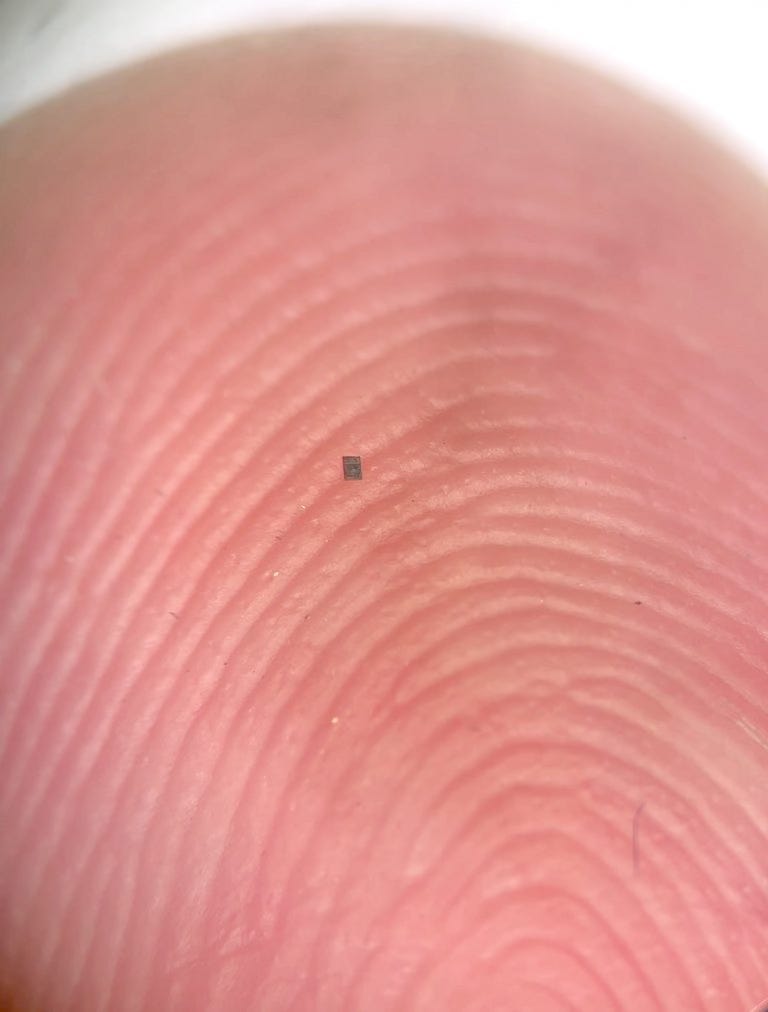
Phenomenal cosmic powers, in an itty bitty living space*
The researchers who built it have some ideas.  Maybe medicine.  Maybe manufacturing.
But honestly, if these things get more sophisticated, what couldn’t they do?
The little guy swims, exclusively. Has to do with the challenges of tiny little legs at that tiny little scale. But, instead of waving flippers about, it moves by manipulating its environment, generating electric currents that coax liquid to flow through and around it.
Basically, it moves forward by making its surroundings move backwards – and vice versa. Absolutely wild, but brilliant.
Despite being sort of a mer-bot, it won’t break if you set it out to dry completely and then drop it back into the drink. And it goes and goes and goes, for months or even years before breaking down.
You can watch it do its thing in these tiny robot movie clips. (WARNING: Clicking the link immediately downloads 131 Mb of clips.)
Things are different down there
The effort to break the Super Small Robot Barrier (not a thing, but let’s make it a thing) began when the lead researchers met at a conference and realized they each held half the key to the microrobot solution.Marc Miskin and his team at the University of Pennsylvania know how to shrink propulsion systems to their limits, while David Blaauw and his team at the University of Michigan know how to shrink microprocessors to their limits.
And miniaturization matters, because it turns out when you get super small, stuff that’s pretty normal at the Scale of Us gets kind of intense at the scale of microbes.
At the truly smallest levels—like at the quantum scale, smaller than an atom—things are genuinely creepy weird. Stuff even pops in and out of existence, the empty vacuum suddenly not so empty, before emptying again in a flash.
The microrobot world isn’t as odd as that, but you still have issues.  Little limbs tend to break off, thin liquids like water offer up more resistance.

In the release, Miskin equates moving through water at the micro scale to moving through tar.
And there are practical issues, like radio transmitters taking too much energy and space. The researchers had to create an entirely new way to communicate, using light pulses to talk to the bots – which then responded by doing wiggle dances like a bee. (Added bonus: the light pulses helped charge the robots’ teensy solar panels.)
Even manufacturing was scaled down. The robots are made the same way as computer chips, engraved into silicon, then popped out like so many baby SIM cards (it’s done with chemicals, but you get the point). They’re so easy to make, they apparently cost only about 1 cent each.
The researchers published their findings in Science Robotics and the Proceedings of the National Academy of Sciences, but this is just a proof of concept. The mind boggles thinking of ways we could eventually use these things . . . most of them not scary.
I’m sorry Dave, I’m afraid I can’t do that**
Robots have a mixed reputation.
Depending on your mood that day, if someone says, “Robot,” your mind will either conjure an image of C-3PO and R2-D2 or HAL 9000 and the Terminator.
Neither sentiment is really accurate. Robots are as good or evil as we make them. Just like AI, they’re only dangerous when people put them in dangerous situations.
In my scifi novel, there are killer robots (who wouldn’t put killer robots in a scifi novel!?), and some of them even have swarms of nanosentinels—really, really small killer robots—that buzz around and cause more havoc. But someone had to give those machines the instructions to go off and do bad things.
(Some robots do take our jobs – my dad testified to Congress about this sort of thing back in the 80s, when robots were transforming manufacturing. And now, some folks want AI to take more. But those are decisions people are making, not the machines.)
Robots are just running through programs, basically switching from one action to another based on internal guidance (”if this happens, do that”) and external guidance (what they see and hear and feel, or what they receive as commands). They cannot nuke humanity unless someone is crazy enough to give a robot a nuke. It’s like placing an armed nuke on a loose shelf – not wise, but the shelf does not have malevolent intent.
But if we’re smart about it, as robots advance, we can direct them to do amazing things.
And we’ve always known it.
An innate desire for a bit of digital assistance
Humans have wanted robots since before we called them robots.  Even in ancient Greek myths, robots show up.
While the word came from Czech—from robota, which basically means serfdom, introduced to the broader world in Karel Čapek’s play “Rossum’s Universal Robots”—the concept of mechanical help is as old as the desire to not want to sweep the floor.
And new robots, like these microscopic ones, are not only capable of doing things we can’t, they’re capable of going places we can’t.
When I mentioned them to my wife, she immediately got excited about the shift in perspective they might bring. These robots could get inside the body and observe, in ways that us relatively enormous fleshy beings cannot, to see processes from a vantage we cannot. (For you fans of Someday, in Science: Imagine if robots get smaller than cells . . . we could watch vaults in real time.)
Robots are evolving as technology evolves, and as society evolves. But the fundamentals in society never really change. Good is good, smart is smart.
Like with all tools that have come before, if we use the next generation of robots with just a bit of care and forethought, they’ll help us do some incredible things.
So what will we do with them?
For more on the new microrobot, check out the press release from the Penn School of Engineering and Applied Science. Their university was founded by Ben Franklin, so they’ve been at this discovery + innovation thing for awhile, and they were kind enough to let me use the subtly mind-blowing photo above.
Post-credits scene: *Yes, that quote is from Aladdin.

**Yes, that quote is from 2001: A Space Odyssey.  HAL 9000 was the OG of killer robots.  He was pretty classy about it, too.
Next week’s Someday in Science: Yes, you can potty train an iguanaLast week’s Someday, in Science: Binge-watching, 400,000 years ago
Thanks for visiting! If you read it, please Like it, so others can find it!

Love these little robots! My psychological prediction is that these will be much more readily accepted by people than robots that resemble humans. If people can't see them, even if they know they're there, they won't mind as long as it's helping them. Once we can make eye contact with robots, all bets are off :)
Reminds me of the old Fantastic Voyage movie!!