
Vaults, pt.2 – Vault Harder
. . . continuing where we left off on vaults, the tiny, strange objects floating through our cells. . .

So, so many
One thing that's clear about vaults—per last week's discussion—is we have a lot of them.

Look at your hand.  Look closely.  Even closer.

In nearly every single cell, there are about 10,000 vaults floating around. In some of our immune cells, that number climbs to 100,000.  In each cell.

We are filthy with these things.

And yet, they are really hard to catch in the act of doing stuff.
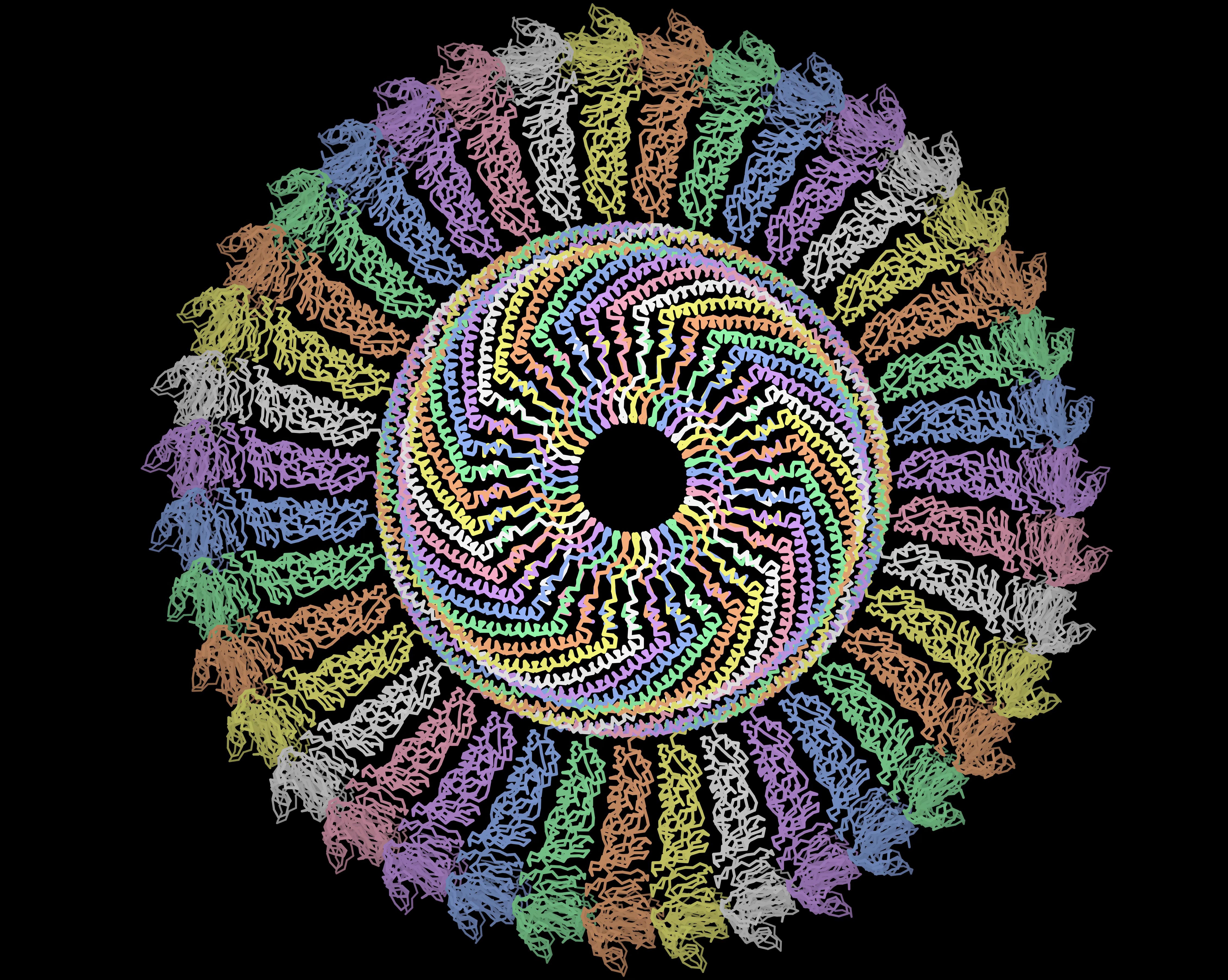
Show me what you've got
Vaults are not easy to see under most microscopes, they don't take to the usual staining and such that can reveal other cell parts.  That's one reason no one saw them until the 1980s.

But, using various tricks—like tagging pieces of vaults with fluorescent markers—scientists can answer some questions.

Where are they in the cell?  (Everywhere!)

How many are there?   (A whole crap-ton!)

Questions like that.

But why, exactly, are they here?
So far, based on where vaults do show up, it seems they may play a role in carrying things around cells, or helping cells respond to threats, like radiation or starvation or disease.

Quite a few vault studies have looked at cancer (where vaults seem to get in the way of chemotherapy) and Parkinson's (where vaults tend to increase in number).

Vaults seem to be doing something.

And yet—and this is where things get really strange—in experiments where mice were bred to have no vaults, nothing obvious happened.  They lived happy, long, mousey lives.  At least in those experiments, vaults didn't seem to matter at all.

Beyond the pretty pictures
Sadly, in our search for answers, we can't just stare at a cell and watch its inner vault story unfold in real time.

Despite all the beautiful animations on YouTube of molecules floating around in cells and doing wonderful things, those are all animations.  It's all art and imagination (though usually based on good science).

If only we could Fantastic Voyage into cells (or Innerspace, for you fellow children of the 80s).

Unfortunately, we cannot swim around and make a movie of what's happening in a cell, and even the world's tiniest robot is way too big to help.

There are a few ways to take cellular snapshots.

Electron cryo-tomography can take a nice picture, for example, if you happen to have a transmission electron cryomicroscope in your basement.  But, while it's incredible to see snapshots at nearly the scale of atoms, they tend to be somewhat fuzzy, and they only show single moments in time.

Fluorescent tagging and other techniques give us some additional information, but they each provide small pieces for a very complex puzzle.

Vaults look cool, and they show up in important places, so we keep the questions coming.  These things might be important.

However, so far, most of vaults’ mysteries remain unsolved.

We're all weird
And that brings us to the lesson from all of this: The human body—all life—is complex, and our understanding of any of it is incomplete.

Even now, in an age of incredible discovery.

Or, to go deeper: Knowledge has its limits. It will always be incomplete, and that's ok.

We have to rely on approximation, and interpretation, and creative ideas to find clues and answers – and new questions.

Discovery just keeps going.

Vaults are another reminder that we haven't figured everything out yet, that there is still mystery in the world, and there always will be.

And for some reason, I find that comforting.
For a little more on vaults, dig deeper in this technical summary paper on vaults in Cellular and Molecular Life Sciences, with great insights into some of the best evidence yet for what purpose vaults serve.  And here's the original article in Science again that sparked my curiosity: "The vault guy"

Post-credits scene: Vault co-discoverer Lenny Rome has a You Tube channel called The Vault Guy!  Check it out, all sorts of explainers and context, and the place to go for the absolute latest on vault science.

Next week's Someday in Science: Binge-watching, circa 400,000 B.C.E.

Last week's Someday, in Science: The adorable nanomachines nearly everywhere in your body that no one really understands (Vaults, pt.1)

Thanks for visiting!  If you read it, please “Like” it, so others can find it!

I can’t say that vaults don’t scare me. The idea that they increase in diseases such as Parkinson’s but don’t appear to not do anything when absent in the mouse makes me wonder if they don’t just clog things up. However, you could write a great science fiction story about them!
I love how over millions of years humans evolved to eventually have brains that became curious about their own bodies and tens of thousands of years after that we're still discovering crazy stuff. These posts on vaults are a great example of that, but also see the gut-brain axis connections that are blowing people's minds!